
Five Senses, One Legacy
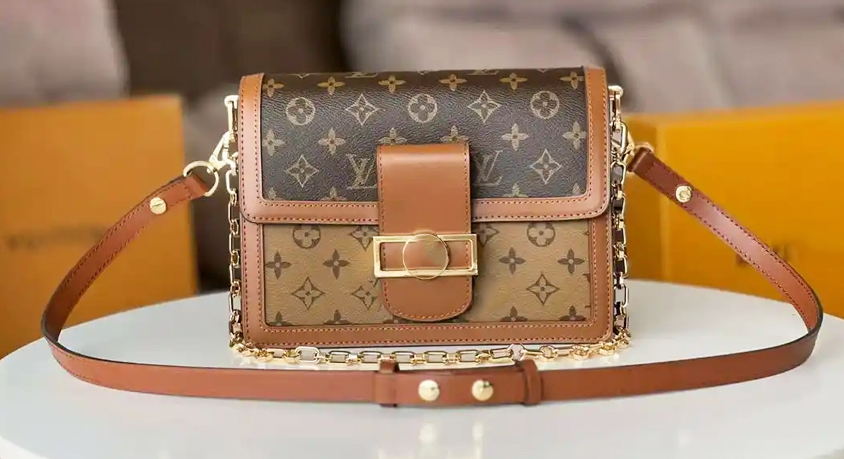
Close your eyes. Let your fingers trace the grain of coated canvas etched with the house’s century-old monogram—firm, textured, yet whisper-light. Hear the snap of the magnetic clasp as it seals with authority. Feel the weight of gold-polish hardware resting against your palm like a pocket-sized sculpture. This isn't just a bag. This is the Louis Vuitton Dauphine.
A revival of a 1976 archival model, the modern Dauphine is a study in deliberate contrast: classic and radical, ornamental and pragmatic, timeless and restless. It’s a story told not in logos, but in tension, panel, and proportion.
Design Trifecta: Material, Structure & Iconography
1. Material Artistry: Coated Canvas Meets Smooth Calf
The Dauphine's body is constructed from Louis Vuitton’s signature Monogram coated canvas—first industrialized in 1896—which undergoes heat pressing at 98°C and texture rolling at 1.1 tons of pressure. It ensures the grain depth is locked at 0.35mm and resists both water and heat up to 70°C (as tested by LV’s wear-lab in Irigny).
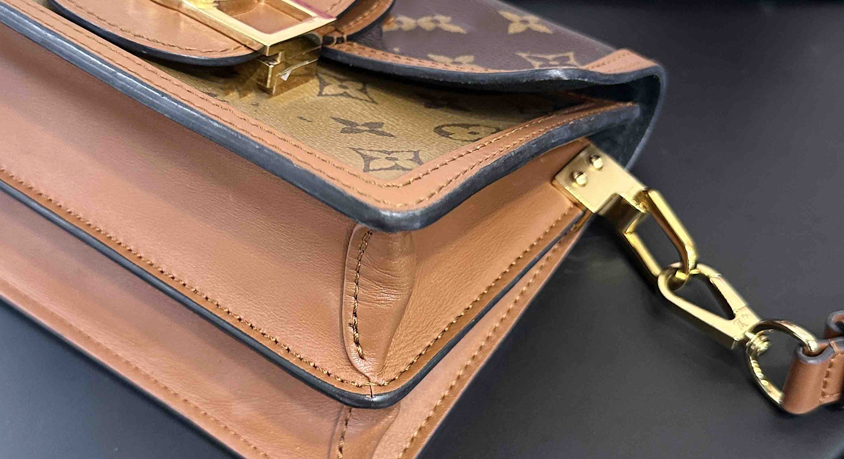
The side panels and trim are rendered in smooth calf leather, tanned with a slow-oxidation tannin bath extending 22 days. This contrasting materiality—patterned canvas against minimal leather—adds a visual “comma” to the bag’s otherwise rhythmic composition.
Limited editions feature Monogram Reverse, Giant canvas, tweed jacquard, or exotic leather inlays such as crocodile or python on the LV circle patch.
2. Structural Philosophy: Geometry with a Purpose
More than a flap bag, the Dauphine is designed as a dual-compartment case. Its trapezoidal base widens by a quiet 4.6° from top to bottom, optimizing stability while keeping the silhouette visually sleek. Inside, accordion folds transition from tight crimps at the top (to create a sleek profile) to relaxed pleats at the bottom—allowing natural expansion.
The outermost edge is finished with painted piping in four coats, cured between each application. Magnetic vs tension-lock debate? Louis Vuitton resolved it: the clasp employs a dual-locking magnetic system that self-aligns, with a resilience threshold of 5.5kg after 10,000 repetitions.
3. Emblematic Hardware: From Utility to Symbol
At the flap’s center is the new-age LV Circle logo—a reinterpretation of the 1970s insignia—crafted via micro-lathing from brass alloy, plated in 18-karat gold tone with electro-coated gloss finish. The internal magnet is precisely pressure-calibrated to “click” into place with one-hand manipulation.
On shoulder versions, the adjustable leather strap with notched hardware glides on twin rails, while the chain edition features flat curb links polished on all six faces. The chain alone requires 45 minutes of assembly, testing, and anti-warp tensioning.
Artisan Heritage: Dauphine and the Human Hand
Every Dauphine is built in Louis Vuitton’s workshops in Ducey and Asnières, France, under a “one artisan, one bag” rule. The artisan cuts Monogram and Reverse panels from separate canvas rolls to ensure perfect seam alignment—any deviation over 1.5° results in discard.
Interior seams are saddle-stitched with beeswax-coated linen thread, ensuring 7–8 stitches per centimeter—a hermetic closure that enables up to 10 years of structural elasticity, even with daily use.
“Getting the flap edges to align with the gusset curve without bulge—that’s the real mastery,” explains a 17-year Ducey-based Louis Vuitton craftsperson. “It’s like fitting corsetry into geometry.”
Dress Codes of the Dauphine: Style in Modularity
Whether carried as shoulder elegance or crossbody power, the Dauphine adapts. Its modular strap and chain system allows wearers to reinvent proportions with outfit and time of day.
Styling Codex:
- For daywear, pair Dauphine MM in Monogram Reverse with cropped navy suiting and horsebit loafers—a nod to Parisian tailoring.
- For evenings, let the Dauphine Mini in black crocodile frame a satin column dress; tuck the strap inside and wear it as a clutch.
- When the chain version is deployed, match warm hardware to tortoiseshell, amber, or yellow diamond jewelry.
Handbag scale principle: the MM version spans no more than 1/7 of your frontal silhouette, maintaining balance and flow.
Care Rituals: Preserving Contrast, Tension, Harmony
Preservation starts with daily habits. Wipe the Monogram canvas gently with a clean, damp microfiber cloth. Avoid alcohol-based cleaners; instead, use a neutral balm once a season, avoiding saturation on calf leather trims.
For interior microfiber, brush gently using a velvet-lined tool to remove dust or soft fallout, moving in a circular pattern. Store with a crescent-shaped insert pillow and slightly loosen the magnetic latch to avoid closing pressure strain.
Pro tip: Wrap the chain strap in silk scarf or use a chain protector sleeve during storage to prevent imprinting on the leather.
Avoid direct sunlight for long durations—the tanning on calf leather can mature unevenly. Controlled humidity of 50–60% is ideal in display cabinets.
Heirloom in Repetition: Why the Dauphine Endures
Unlike trend-signifying bags that fade with their influencers, the Dauphine has no timestamp. It’s rebirth and refinement rolled into one: historic monogram, modern clasp, modular form. It is as collectible as it is practical, often featured in Louis Vuitton's capsule “Catwalk Re-Editions,” yet produced in controlled volumes to preserve desirability.
Collectors prize the Dauphine for its archived roots, dynamic silhouette, and low exposure fatigue—making it ideal for both seasoned connoisseurs and next-generation legacy holders.
To carry a Louis Vuitton Dauphine is to carry duality distilled: ornate and spare, retro and future-facing, bold and impeccably disciplined. Like all great architecture, what begins in design ends in permanence.
And in the snap of that clasp,
you don't just hear a closure—
you hear another chapter of Louis Vuitton opening.