
When a Glimpse Becomes a Signature
It begins with a subtle sound: the delicate lift of a twist-lock clasp, followed by a whisper-like rustle as the supple leather reveals its inner lining—silk, suede, or color-blocked Nappa, depending on the edition. The two separate compartments gently part like the opening of a stage curtain. This isn’t just a handbag. It’s a tensioned sculpture in motion.
The Fendi Peekaboo, originally introduced for Spring/Summer 2009 by Silvia Venturini Fendi, celebrates paradox. Its design is simultaneously open and private, soft and structured, contemporary yet classically Roman. Over a decade since its debut, it remains one of the most quietly iconic silhouettes in modern handbag history—a slow-burning symbol of discreet luxury.
Designed in Layers: Material, Geometry, Meaning
Material Alchemy: Roman Calfskin with a Silent Grain
At the heart of Fendi's Peekaboo is its leather—a creamy, high-density Roman calfskin tanned over 21 days using bark-based vegetal compounds, then drum-rolled for 150 minutes to achieve a subtle gloss-free finish. Its thickness (usually 1.4mm) is calibrated to support weight without succumbing to collapse, while remaining pliable enough for daily use.
In special editions, Fendi incorporates exotic materials like Cuoio Romano, crocodile, python, and even Selleria leather—stitched by hand in Fendi’s in-house atelier with saddle tradition. Every grain and fold tells a story of tactility. The bag doesn’t shout—it hums with material intelligence.
Structural Duality: Hardware Born from Architecture
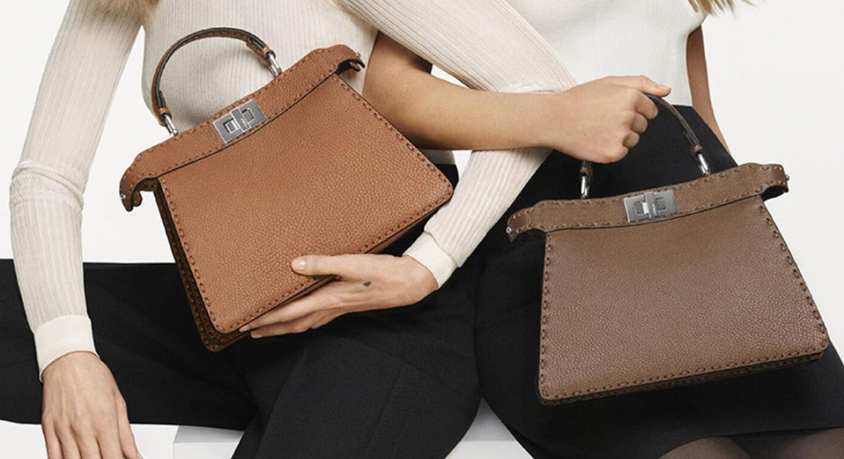
The Peekaboo's defining element is its central partition frame—an internal divider lined with metal tubing that upholds the bag’s posture. The structure is what allows the bag to be partially unfastened yet fully composed. Each half opens asymmetrically, a nod to Fendi’s Roman heritage of tension and symmetry (consider the Pantheon’s dome or the broken pediments of Baroque facades).
The hardware—especially the twist-lock closure—is cast from highluster brass, hand-polished over felt wheels for 40 minutes to remove casting lines. This clasp anchors the top bridge and rotates on a fixed axis with a 90° range: tactile, reassuring, durable.
Inner Expression: A Lining Meant to Be Seen
Unlike most luxury bags, the Peekaboo’s interior is never incidental. Often, it reveals bold contrast linings: fire-red Nappa leather against a slate exterior, herringbone wool set beneath black crocodile—all employing what Fendi calls 'inside-out luxury.' The lining becomes an emotionally coded space: a flash of exuberance, a message, a mirror to its owner’s secret self.
Crafted Without Compromise: The Atelier’s Role
Peekaboo bags are assembled in Fendi’s artisan studios outside Florence. Each creation involves no fewer than 228 steps over an average span of 12 hours. “Precision of the fold is everything,” says a Fendi leatherworker with 16 years of experience. “One millimeter misaligned, and the entire tension system collapses.”
Selleria versions feature visible hand stitching in thick linen thread using a double-needle crisscross technique derived from Roman saddle-making. The result: a bag that holds not just belongings—but memory.
Style in Balance: Composition over Trends
Sophisticated yet playful, the Peekaboo moves fluidly between aesthetics. On the runway or in the boardroom, it never overstates itself—it complements and anchors. The most popular sizes—Peekaboo ISeeU Medium and Petite—offer versatile carry options including top-handle grip and adjustable crossbody strap.
Styling Notes:
- Pair the Medium Peekaboo in Pearl Grey Selleria with a belted cream trench and block-heeled boots for tonal minimalist elegance.
- A Mini version in Emerald Green crocodile leather elevates a black jumpsuit or tuxedo-style blazer for ultra-modern eveningwear.
- Hardware hues (palladium vs gold-tone) should echo personal jewelry palettes for visual harmony.
Recalling classic proportions, the Peekaboo aligns best when its width doesn’t exceed 1/7 of the wearer’s full shoulder span—keeping presence effortless.
Care and Continuity: How to Keep It Living
To preserve leather integrity, gently remove surface debris with a microfiber cloth weekly. For Roman calfskin, apply a pea-sized amount of neutral leather balm once every three months, working it in with barefoot fingertips in slow circular motion. Let it rest for 10 minutes before light buffing.
Use a structured insert pillow to maintain its signature silhouette when stored. Store upright in its felt pouch, away from direct light and seasonal humidity spikes (ideally 55%). Avoid prolonged pressure on the twist-lock area, especially when half-opened, which could stress the hinge system over time.
Why It Transcends Time
What makes the Peekaboo special isn’t just its outer design—it’s its inner grammar. It suggests that true luxury reveals itself only with time and closeness. A bag not meant simply to be seen, but understood.