
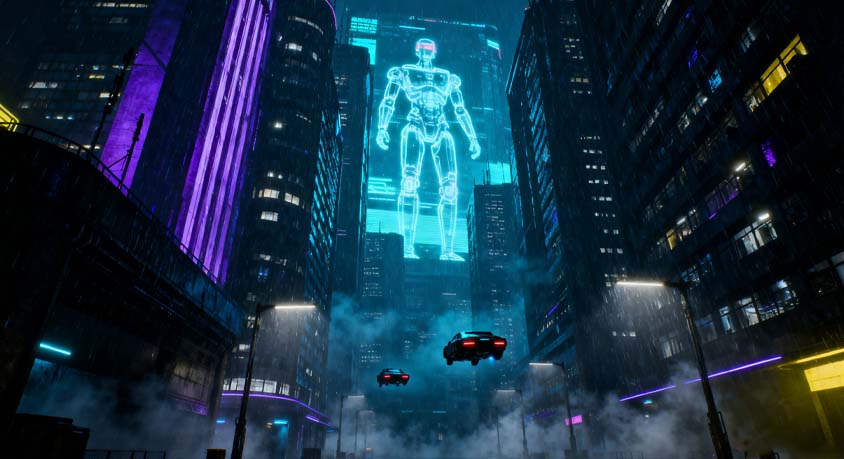
My friend Javi is a total sci-fi nerd—he’d rewatch Blade Runner just to stare at the neon ads—but even he wasn’t ready for this futuristic open-world game. He texted me on a Tuesday night: “I just walked into a shop in the 2077-set city, and the guy behind the counter asked if I wanted to swap my arm for a metal one. What should I do?” By Wednesday, he was FaceTiming me, holding up his controller like it was a trophy: “This thing lets me lift cars. I just tossed an enemy into a neon sign. It’s insane.” That’s the vibe of this game’s world: a city where “body mods” (they call ’em “cyberware”) aren’t just for flex—they’re your superpowers. But by the weekend, Javi was quieter: “I swapped my eyes for ones that let me see through walls… but now I keep forgetting which memories are mine. Is that weird?” Suddenly, the neon glow of the city felt less like a fun aesthetic, and more like a question: When you can rewrite your body, do you still stay you?
Let’s start with the fun part—the cyberware flex. The city’s packed with shops that sell everything: arms that shoot electricity, legs that let you jump 10 feet, even neural mods that let you hack enemy guns mid-fight. Javi’s first big swap was a “reinforced tendons” mod for his legs. He sent me a clip: his character ran up a vertical wall, flipped over a guard, and landed like a cat. “I used to die every time I tried to escape—now I’m parkouring over skyscrapers,” he laughed. The game makes these mods feel personal: you don’t just “unlock” them—you save up cash, argue with shopkeepers about upgrades, and even customize the look (Javi added neon blue grain to his mechanical arm “so it matches the city”). It’s not just power—it’s style. For a while, he was obsessed: “Why walk when I can sprint? Why punch when I can shock?”
Then the questions hit. Javi wanted a “neural link” mod that let him slow down time—perfect for dodging bullets. But the shopkeeper warned him: “Too many neural mods, and your brain starts mixing up real and fake.” He hesitated. “What if I forget my mom’s birthday because my brain’s too busy processing time slowdown?” he asked me. That’s the game’s secret edge—it doesn’t just let you play with cool tech; it makes you think about it. Javi ended up buying the mod, but he used it sparingly. “Every time I slow down time, I check my in-game ‘memory log’—just to make sure I still remember why I’m here,” he said. The city’s full of little moments like that: NPCs who’ve swapped so much cyberware they can’t remember their own names, or activists yelling that “cyberware isn’t progress—it’s erasure.” It’s not preachy—just a quiet nudge to ask: Where’s the line between “enhancing” yourself and “replacing” yourself?
And let’s talk about the aesthetic—this game turns cyberware into art. Javi’s favorite mod? A “thermal optic” eye that glows bright pink when he uses it. “It’s not just useful—it’s a flex,” he said. He’d post screenshots of his character leaning against a neon sign, eye glowing, mechanical arm resting on a bike. The city’s full of people like that: someone with a chest plate covered in LED patterns, another with hair woven with fiber-optic strands. Cyberware isn’t just functional—it’s how you express who you are. “I saw a NPC with an arm that doubles as a guitar,” Javi said. “He wasn’t fighting—he was playing music on a street corner. That’s when I got it: It’s not about being a warrior. It’s about making your body yours.”
By the end of the month, Javi had a closet full of cyberware—but he’d settled into a rhythm: mechanical arm for lifting, thermal eye for scouting, time-slow mod only for emergencies. “Here’s the tea,” he told me. “It’s not about ‘losing yourself’—it’s about choosing what parts of you to keep. My character’s still me—just with an arm that can shoot electricity.” That’s the magic of this game: it doesn’t just give you superpowers. It makes you ask what you’d do with them—and who you’d be if you could rebuild yourself, one neon-lit mod at a time. Last week, he sent me a screenshot: his character standing on a rooftop, city lights below, mechanical arm outstretched. The caption? “Still me. Just cooler.”