
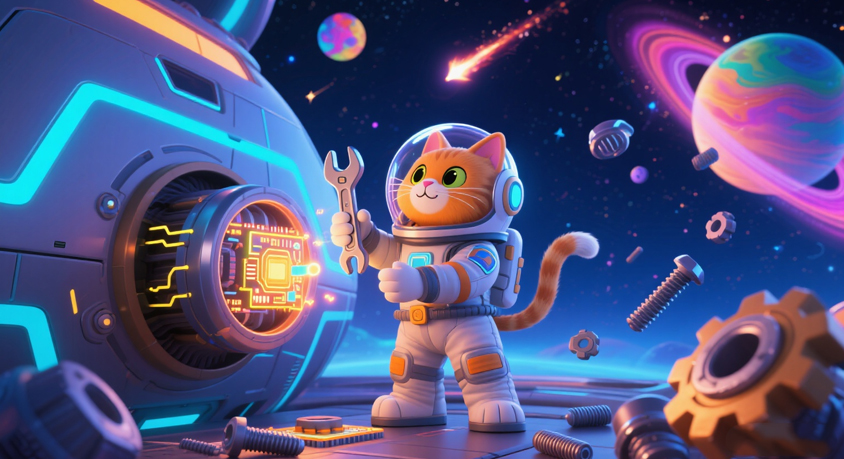
My friend Leo sent me a voice memo at 2 a.m. last year, half-yelling over the hum of his laptop: “I’m making a game about a space cat who fixes broken planets! It’s gonna be epic!” I laughed, but I also knew he meant it—he’d spent months scribbling ideas on napkins, replaying old indie hits like Stardew Valley for inspiration, and arguing with me about whether the cat should have a laser pointer or a wrench. Sixteen months later, his game, Cosmic Kitty Repair, was live on Steam. But here’s the tea: it wasn’t all late-night creative highs. There were weeks he ate nothing but ramen because he blew his budget on a freelance artist. Days he wanted to delete all his code because a bug broke the main quest. And one panic attack when his Kickstarter only hit 30% of its goal in the first week. Becoming an indie dev isn’t about “following your dream”—it’s about surviving the chaos between the dream and the launch.
Let’s start with the idea part—because everyone has a “space cat” idea, but not everyone turns it into something real. Leo didn’t just say “space cat”; he asked: Who is this cat? (A grumpy retired mechanic.) What do players do? (Solve puzzles to fix planets, but with side quests to collect space snacks.) What makes it different? (No combat—just chill problem-solving, because he hated how most space games felt stressful.) He even made a mood board on Pinterest: photos of nebulas, cute cat plushies, and vintage toolkits. “Ideas are cheap,” he told me later. “The work is asking ‘why’ until your idea feels like the real world.” Pro tip: If you can’t explain your game in one sentence (“space cat fixes planets”), it’s too vague. Write it down, test it on a friend who doesn’t play games—if they get it, you’re on track.
Then there’s the “team vs. solo” debate. Leo started solo: coding after his day job, teaching himself pixel art via YouTube tutorials, and begging me to playtest every rough version. But after three months, he realized he sucked at animation—his cat walked like a stiff robot. So he hired a freelance artist from Fiverr (budget: $200 a month, paid out of his coffee fund) and a friend who knew sound design to make the cat’s meows. “Solo is great for control, but it’s a death sentence for burnout,” he said. If you can’t afford a team? Trade skills: Leo helped a writer friend with their website in exchange for dialogue writing for his cat. No money? Use free tools—Unity has a free tier, Audacity for sound, Canva for social media art. You don’t need a big budget; you need to be scrappy.
Funding is where most indie devs crash and burn. Leo’s first plan: Kickstarter for $10k to pay the artist and buy a better laptop. After a week, he had $3k and was panicking. Then he changed his approach: he posted a 60-second video of the cat fixing a planet (buggy, but charming) and added a stretch goal: “If we hit $5k, the cat gets a tiny space hat.” Suddenly, people started sharing—pet lovers, indie game fans, even a few cat TikTokers. He hit $8k in two weeks. “Don’t ask for ‘money for the game,’” he said. “Ask people to fund something fun—like a space hat. They want to feel like they’re part of the creation.” If Kickstarter fails? Try Patreon (monthly support for dev logs) or pitch small publishers—just read the fine print. Leo talked to one publisher who wanted 50% of profits; he walked away. “Better to make less money than lose control of your cat,” he joked.
Marketing isn’t about “promoting”—it’s about making friends. Leo didn’t post “buy my game”; he posted dev logs: “Today I fixed the cat’s walk cycle (it no longer looks like it’s doing the cha-cha)!” or “Here’s a sneak peek of the ice planet—the cat slips on ice. It’s dumb, but I love it.” He posted on TikTok, Reddit, and even Discord servers for indie game fans. When someone commented, “Can the cat have a fish toy?,” he added it—and tagged that person in the update. By launch day, he had 2,000 followers who felt like they “helped make the game.” On launch day, half of his first sales were from people who’d followed his dev logs. “Marketing is just talking about your game like you’re talking to a friend,” he said. “No salesy vibes—just excitement.”
Finally, the Steam launch. Leo spent a month filling out Steam’s forms (he called it “worse than taxes”) and testing for bugs—he even paid a QA tester $100 to play for 10 hours. On launch day, he woke up at 6 a.m., refreshed his Steam page every 5 minutes, and cried when he saw the first sale (a person in Brazil bought it). By the end of the week, he had 150 sales—not enough to quit his day job, but enough to pay for the artist and buy himself a fancy coffee. “Launch isn’t the end,” he said. “I’m still updating the game—adding more planets, fixing bugs people report. Indie dev is a marathon, not a sprint.”
Here’s the real survival tip: Leo didn’t “make it big”—but he made something real. He didn’t burn out because he took breaks (even if they were just 10-minute walks with his real cat). He didn’t quit when the Kickstarter struggled because he focused on the small wins (like the first person who said “this looks fun”). If you want to be an indie dev? Start small. It starts to get messy. Start with the thing that makes you excited—whether it’s a space cat, a farming sim, or a puzzle game about baking. And remember: the best indie games aren’t made by people who want to get rich—they’re made by people who can’t stop talking about their ideas. Leo still sends me voice memos at 2 a.m., now about adding a dog sidekick to Cosmic Kitty. That’s the vibe—love the process, even when it’s chaotic.